At a glance Selected evidence in this atlas Studied use & population Adults with obesity or overweight and at least one weight-related comorbidity; no type 2 diabetes
Study context Selected efficacy evidence 11.8% reported weight loss · 0.3% loss with placebo · 36 weeks
VISTA · Phase 2b · sponsor · 75 mg once daily; weekly dose escalation · Assuming continued treatment
Evidence & limitations Important safety context Predominantly mild-to-moderate GI events; 75 mg nausea 55%, vomiting 29%; no liver safety signal reported.
Safety context Study results apply to their own population, dose and analysis. They do not establish a ranking between therapies.
At a glance Evidence & safety Development timeline Biology & identity Molecule
Evidence in the atlas 2 results Each result belongs to its own study population, dose and analysis. Open a result for its chart, comparator, safety findings and limitations.
Weight loss 11.8% reported weight loss · 0.3% loss with placebo · 36 weeks
75 mg once daily; weekly dose escalation
Adults with obesity or overweight and at least one weight-related comorbidity; no type 2 diabetes
Efficacy estimand; week 36 is the end of treatment, while co-primary endpoints were at week 26. Investigational; phase 3 program announced
Safety context Predominantly mild-to-moderate GI events; 75 mg nausea 55%, vomiting 29%; no liver safety signal reported.
Limitations: Efficacy estimand rather than treatment-policy; results simultaneously published in The Lancet.
Glucose control 1.9 percentage-point HbA1c decrease · 0.2 pp decrease with Placebo · 26 weeks
75 mg daily; dose increased every 4 weeks
Adults with type 2 diabetes
Efficacy estimand excludes data after permanent discontinuation, rescue medication, or death.
Safety context At this dose/titration: nausea 37%, constipation 29%, diarrhea 21%, vomiting 18%; placebo 3%, 4%, 15%, and 1%. Serious hypoglycemia was not reported.
Limitations: 406 randomized; 404 treated. Slow titration is a distinct arm from 75 mg with 2-week escalation. Values rounded as in sponsor release.
Biology & identity Status in this atlas: Investigational; phase 3 program announced
Hormone activity An oral small molecule that activates GLP-1 receptors.
What do these hormones do? GLP-1
Investigational; no approved trade name identified as of 2026-09-13. Elecoglipron, AZD5004 and ECC5004 identify the same development compound, not regional brands.
AstraZeneca · Exclusive development and commercialization rights outside China; development/commercialization alongside Eccogene in China.; Eccogene · Originator of ECC5004; licensor retaining the right to co-develop and co-commercialize in China.
Uses, doses and availability depend on the formulation, indication and country. Study doses below describe research; they are not prescribing instructions.
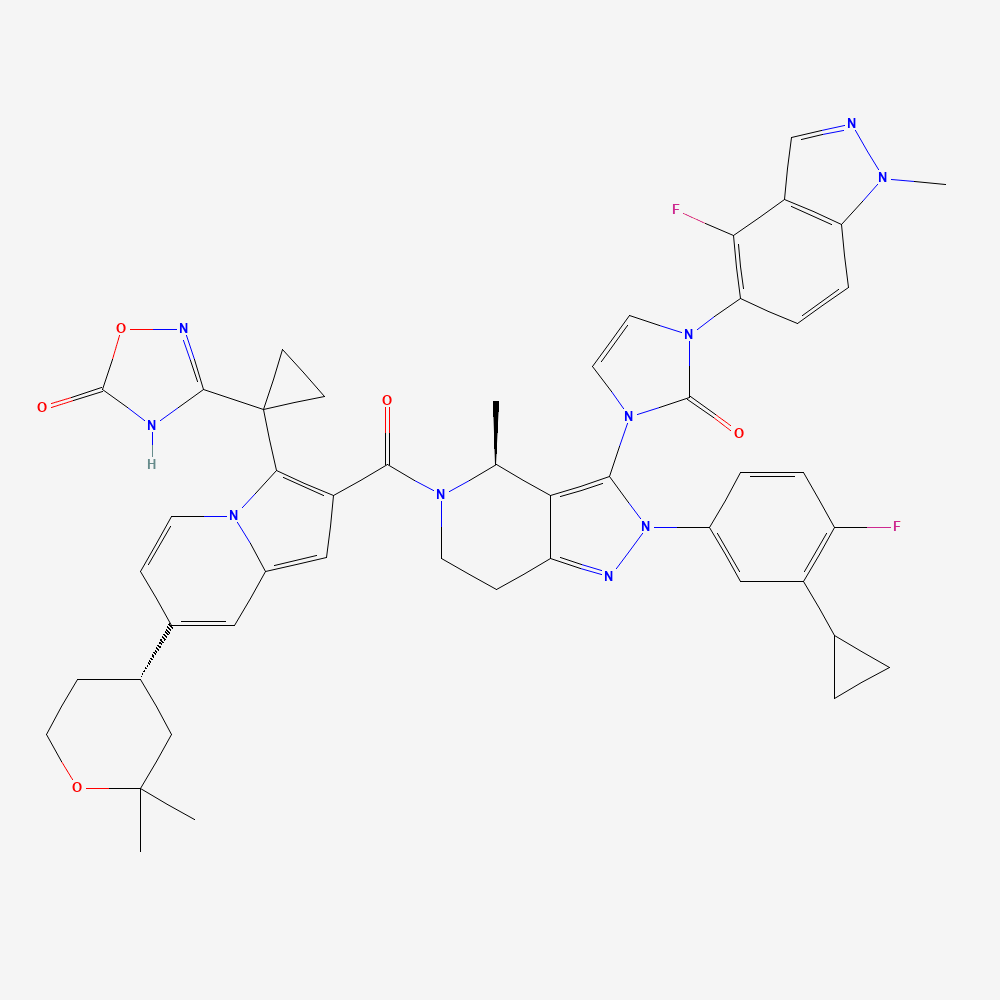
The molecule 2D chemical structure Elecoglipron · 2D chemical structure Chemical connectivity and stereochemistry of Elecoglipron.
Shown: Active compound as represented in the named PubChem record; formulation excipients excluded.
A two-dimensional chemical diagram shows bonds and stereochemistry, not a measured three-dimensional shape.
PubChem, National Library of Medicine
PubChem CID 169644648 Development timeline Next milestone A next milestone is not summarized for this therapy. This does not mean development has ended.
Development history 2 selected milestones Elecoglipron · compound history across indications
Selected milestones only. Earlier studies may be missing; the first listed date should not be interpreted as the start of development.
Nov 9, 2023
AstraZeneca licence announced Eccogene licensed ECC5004 globally to AstraZeneca, with Eccogene retaining China co-development and co-commercialization rights.
Source Jun 8, 2026
Phase 2b results and phase 3 plans AstraZeneca presented VISTA obesity and SOLSTICE type 2 diabetes results, published in The Lancet, and announced a phase 3 program.
Source Selected sources checked Sep 13, 2026. This is not an exhaustive history.