All therapiesEvidence snapshot 2026-09-14
Lipids & cardiovascular health

Inclisiran

Uses RNA interference to break down PCSK9 messenger RNA in liver cells, reducing PCSK9 production. Source

At a glance

Selected evidence in this atlas
Studied use & population

Adults with ASCVD and elevated LDL-C

Study context
Approval & development

Selected approval record (2021-12-22): FDA approved inclisiran as an adjunct to diet and maximally tolerated statin therapy for adults with HeFH or clinical ASCVD who required additional LDL-C lowering.
Status sourceStatus & indications
Selected efficacy evidence

LDL-C: 52 percentage-point reduction vs placebo · Day 510 (about 73 weeks)

ORION-10 (NCT03399370) · Phase 3 · regulatory-label · 284 mg initially, at 3 months, then every 6 months · LDL-C: ANCOVA with adherence-sensitive multiple imputation; other markers: MMRM/pattern-mixture imputation.

Evidence & limitations
Important safety context

Pooled label safety: injection-site reactions 8% vs 2% with placebo.

Safety context
Next milestone

A next milestone is not summarized for this therapy.

Milestone details

Study results apply to their own population, dose and analysis. They do not establish a ranking between therapies.

Evidence in the atlas

2 results

Each result belongs to its own study population, dose and analysis. Open a result for its chart, comparator, safety findings and limitations.

Lipid lowering

ORION-10 (NCT03399370)

LDL-C: 52 percentage-point reduction vs placebo · Day 510 (about 73 weeks)

284 mg initially, at 3 months, then every 6 months

Adults with ASCVD and elevated LDL-C

LDL-C: ANCOVA with adherence-sensitive multiple imputation; other markers: MMRM/pattern-mixture imputation.

Safety context

Pooled label safety: injection-site reactions 8% vs 2% with placebo.

Limitations: Biomarker trial; LDL reduction is not a measured cardiovascular-outcome effect. Nominal day 510 divided by seven for the week axis.

Lipid lowering

ORION-10 (NCT03399370)

Lp(a): 26 percentage-point reduction vs placebo · Day 540 (about 77 weeks)

284 mg initially, at 3 months, then every 6 months

Adults with ASCVD and elevated LDL-C

Median percent change in Lp(a), separately reported at day 540.

Safety context

Injection-site reactions are the principal tolerability issue.

Limitations: Lp(a) uses a later visit and a median statistic; kept separate from day-510 LDL/ApoB. Baseline Lp(a) was 122 nmol/L, not mg/dL.

Biology & identity

Status in this atlas: Selected approval record (2021-12-22): FDA approved inclisiran as an adjunct to diet and maximally tolerated statin therapy for adults with HeFH or clinical ASCVD who required additional LDL-C lowering. Status source

Uses RNA interference to break down PCSK9 messenger RNA in liver cells, reducing PCSK9 production.

Mechanism source

Uses, doses and availability depend on the formulation, indication and country. Study doses below describe research; they are not prescribing instructions.

The molecule

Small interfering RNA

Inclisiran

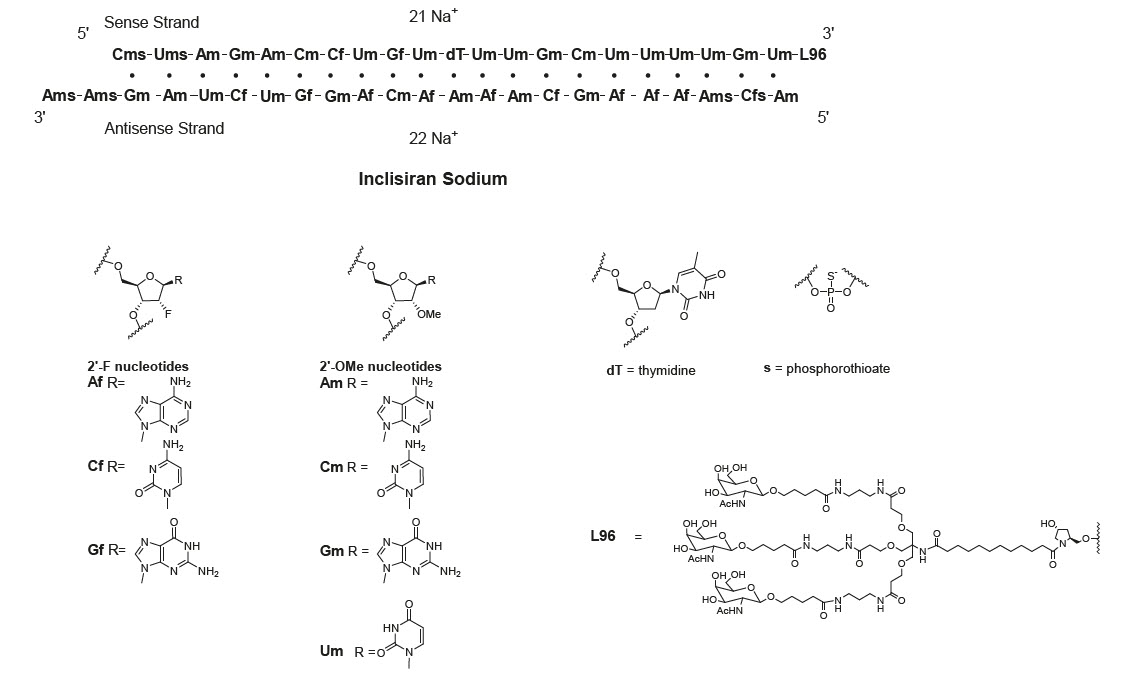
Chemically modified, double-stranded siRNA with a three-arm GalNAc ligand attached to the sense strand.

Shown: Inclisiran sodium; label diagram shows sequence, modifications, ligand, and sodium counterions.

Exact drug-specific chemical/sequence diagram from the label. This is a 2D representation, not a measured 3D RNA conformation. The linked label explains all abbreviations.

DailyMed Leqvio label, section 11

Development timeline

Next milestone

A next milestone is not summarized for this therapy. This does not mean development has ended.

Development history4 selected milestones

Inclisiran · compound history across indications

Selected sourced milestones, not a complete development history. Dates distinguish study starts, publications, announcements and approvals; the first listed date is not necessarily when development began.

  1. Publication

    Phase 1 RNA interference results

    The early study of ALN-PCSsc, subsequently named inclisiran, reported sustained PCSK9 and LDL-C lowering after subcutaneous dosing. The date is the online publication, before the January 2017 journal issue.

    A Highly Durable RNAi Therapeutic Inhibitor of PCSK9 — NEJM; online November 13, 2016
  2. Publication

    ORION-1 phase 2 results

    The 501-participant dose-finding trial evaluated single-dose and two-dose regimens in people at high cardiovascular risk. LDL-C reductions supported the longer-interval dosing program.

    Inclisiran in Patients at High Cardiovascular Risk with Elevated LDL Cholesterol — NEJM (2017)
  3. Publication

    ORION-10 and ORION-11 phase 3 results

    The two pivotal trials reported approximately 50% LDL-C reductions with inclisiran. ORION-10 is the source trial for the lipid comparison plotted here; these were lipid-efficacy trials rather than dedicated cardiovascular-outcome trials.

    Two Phase 3 Trials of Inclisiran in Patients with Elevated LDL Cholesterol — NEJM (2020)
  4. Approval

    First U.S. approval: Leqvio

    FDA approved inclisiran as an adjunct to diet and maximally tolerated statin therapy for adults with HeFH or clinical ASCVD who required additional LDL-C lowering.

    FDA Leqvio original approval package — approval December 22, 2021

Selected sources checked Sep 14, 2026. This is not an exhaustive history.