All therapiesEvidence snapshot 2026-09-29
Weight & glucose

Semaglutide

Activates GLP-1 receptors. Oral and injected semaglutide have the same receptor target; formulation and dose differ.

At a glance

Selected evidence in this atlas
Studied use & population

Adults with obesity, or overweight plus a weight-related condition, without diabetes

Study context
Approval & development

FDA-approved for adult weight management (Wegovy)

Status sourceStatus & indications
Selected efficacy evidence

14.9% reported weight loss · 2.4% loss with placebo · 68 weeks

STEP 1 · Phase 3 · peer-reviewed · 2.4 mg once weekly · Regardless of stopping treatment

Evidence & limitations
Important safety context

GI effects usually transient; GI-related discontinuation 4.5% versus 0.8% placebo.

Safety context
Next milestone

A next milestone is not summarized for this therapy.

Milestone details

Study results apply to their own population, dose and analysis. They do not establish a ranking between therapies.

Evidence in the atlas

7 results

Each result belongs to its own study population, dose and analysis. Open a result for its chart, comparator, safety findings and limitations.

Weight loss

OASIS 4

13.6% reported weight loss · 2.2% loss with placebo · 64 weeks

25 mg once daily

Adults with obesity, or overweight plus a weight-related condition, without diabetes

Effect regardless of treatment discontinuation or rescue weight-management treatment FDA-approved December 22, 2025 for adult weight management (Wegovy pill)

Safety context

GI adverse events 74.0% versus 42.2% placebo.

Limitations: Endpoint is week 64; total trial including follow-up was 71 weeks. Distinct from oral 50 mg.

Weight loss

STEP 1

14.9% reported weight loss · 2.4% loss with placebo · 68 weeks

2.4 mg once weekly

Adults with obesity, or overweight plus a weight-related condition, without diabetes

Effect regardless of treatment discontinuation or rescue weight-management treatment FDA-approved for adult weight management (Wegovy)

Safety context

GI effects usually transient; GI-related discontinuation 4.5% versus 0.8% placebo.

Limitations: Different populations, durations and titration schedules prevent causal cross-trial ranking.

Weight loss

STEP UP

18.7% reported weight loss · 3.9% loss with placebo · 72 weeks

7.2 mg once weekly

Adults with BMI at least 30, without diabetes

Effect regardless of treatment discontinuation or rescue weight-management treatment FDA-approved March 19, 2026 for adult weight management (Wegovy HD)

Safety context

GI events 70.8%; dysaesthesia 22.9% versus 0.5% placebo.

Limitations: Different populations, durations and titration schedules prevent causal cross-trial ranking.

Glucose control

SUSTAIN 2

1.5 percentage-point HbA1c decrease · 0.7 pp decrease with Sitagliptin 100 mg daily · 56 weeks

1 mg weekly

Adults with type 2 diabetes

ITT ANCOVA; randomized and exposed population; missing data imputed using retrieved dropouts.

Safety context

Label describes GI adverse reactions; no trial-specific rate extracted.

Limitations: FDA-label estimates rounded to one decimal; analysis N differs from total randomized N.

Glucose control

REIMAGINE 2

1.68 percentage-point HbA1c decrease · 0.62 pp decrease with Placebo · 68 weeks

2.4 mg weekly

Adults with type 2 diabetes

Treatment-regimen estimate, regardless of treatment discontinuation or additional glucose-lowering therapy.

Safety context

GI events 53.9%; adverse-event discontinuation 6.6%.

Limitations: Trial-wide baseline. Results do not establish superiority across unrelated trials. Diabetes brand information identifies the compound, not approval of this trial dose.

Glucose control

ACHIEVE 3

1.47 percentage-point HbA1c decrease · 1.91 pp decrease with Orforglipron 36 mg trial capsule · 52 weeks

14 mg daily

Adults with type 2 diabetes

Treatment-regimen estimate, regardless of treatment discontinuation or additional glucose-lowering therapy.

Safety context

GI events 45%; adverse-event discontinuation about 5%.

Limitations: Open-label; trial-wide baseline. Diabetes oral formulation; not the 25 mg obesity dose.

Body composition

BELIEVE

17.8 kg body-weight loss with bimagrumab + semaglutide vs 14.2 kg with semaglutide · 48 weeks

The combination used bimagrumab 30 mg/kg plus semaglutide 2.4 mg; the comparison arm used semaglutide 2.4 mg plus bimagrumab placebo.

Adults with BMI ≥30, or ≥27 with an obesity-associated complication; diabetes excluded.

Least-squares means, treatment-regimen estimand: all randomized participants regardless of adherence or discontinuation; placebo-based imputation for missing values. Uncertainty below is standard error, not CI.

Safety context

Muscle spasms, acne and diarrhea were more frequent with bimagrumab. LDL cholesterol increased with the combination.

Through week 48 · 57 participants were randomized per selected arm; 55 combination recipients and 56 semaglutide recipients received at least one study-treatment dose and entered the safety analysis.

Safety results & reporting details

Limitations: Phase 2; nominal comparisons without multiplicity adjustment. Lean mass is not direct muscle measurement. Most grip-strength comparisons were nonsignificant. Muscle spasms, diarrhea, acne and laboratory/lipid changes matter; the 72-week extension is open-label and post hoc. A later withdrawal abstract reports partial regain after treatment stopped; see the safety notes for its separate follow-up population and limitations.

Biology & identity

Status in this atlas: FDA-approved for adult weight management (Wegovy) Status source

Hormone activity

Activates GLP-1 receptors. Oral and injected semaglutide have the same receptor target; formulation and dose differ.

Wegovy (injection)
U.S. weight-management injection; STEP 1 studied 2.4 mg weekly. Additional cardiovascular and MASH indications apply to specified populations. · injection
Wegovy HD
U.S. 7.2 mg weekly weight-management injection for eligible adults; this higher-dose regimen was studied in STEP UP. · injection
Wegovy (pill)
U.S. oral weight-management product with a 25 mg daily maintenance dose; also labeled for cardiovascular risk reduction in specified adults. · oral
Ozempic (injection)
U.S. once-weekly type 2 diabetes product; it is not the Wegovy weight-management formulation. · injection
Rybelsus
U.S. oral type 2 diabetes product; the current label also covers cardiovascular risk reduction in high-risk adults with type 2 diabetes. It is not Wegovy 25 mg. · oral
Ozempic (tablets)
The January 2026 U.S. label also names Ozempic tablets for type 2 diabetes and cardiovascular risk reduction in high-risk adults with type 2 diabetes. Rybelsus and Ozempic tablets are not substitutable milligram for milligram. · oral

Novo Nordisk · Developer and manufacturer of the branded semaglutide products.

Uses, doses and availability depend on the formulation, indication and country. Study doses below describe research; they are not prescribing instructions.

The molecule

Peptide structure

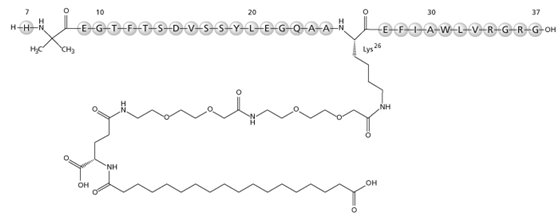
Semaglutide · official structural formula

The active peptide and its covalent lipid/linker modifications, reproduced from the official product label.

Shown: Active peptide; formulation excipients excluded.

Official two-dimensional structural formula. The letters denote amino-acid residues; the lipid side chain and linkers are included. This is not an experimental three-dimensional conformation.

Novo Nordisk prescribing information via DailyMed/NLM

DailyMed WEGOVY label, section 11

Development timeline

Next milestone

A next milestone is not summarized for this therapy. This does not mean development has ended.

Development history10 selected milestones

Semaglutide · compound history across indications

Selected phase 2 and phase 3 diabetes milestones before approval, followed by later formulations and indications. Phase 1 and preclinical development have not yet been reconstructed.

  1. Study start

    Phase 2 diabetes dose-finding study begins

    NCT00696657 began comparing once-weekly semaglutide with placebo and liraglutide. This is the actual study-start date, not the later registry-posting or publication date.

    ClinicalTrials.gov · NCT00696657
  2. Study start

    Phase 3a SUSTAIN-1 begins

    The trial began evaluating once-weekly semaglutide monotherapy against placebo in type 2 diabetes. Novo Nordisk’s clinical study report records this initiation date.

    Novo Nordisk clinical study report · SUSTAIN-1 · page 2
  3. Publication

    Phase 3 SUSTAIN-1 results published

    The phase 3a monotherapy trial reported efficacy and safety online in The Lancet Diabetes & Endocrinology, before Ozempic’s U.S. approval.

    Sorli et al. · The Lancet Diabetes & Endocrinology
  4. Approval

    Ozempic injection approved in the U.S.

    FDA approval for once-weekly semaglutide to improve glycemic control in adults with type 2 diabetes.

    Source
  5. Approval

    Rybelsus approved in the U.S.

    FDA approval established oral semaglutide for type 2 diabetes; this was not the later obesity-dose Wegovy pill.

    Source
  6. Approval

    Wegovy injection approved for weight management

    FDA approved the 2.4 mg weekly obesity product, alongside reduced-calorie eating and increased activity.

    Source
  7. Approval

    Wegovy pill approved in the U.S.

    Novo Nordisk announced FDA approval of once-daily oral semaglutide 25 mg for weight management and specified cardiovascular risk reduction.

    Source
  8. Approval

    Wegovy HD approved in the U.S.

    FDA approved the 7.2 mg injection for weight loss and long-term maintenance in eligible adults.

    Source
  9. Announcement

    STEP Young pediatric topline reported

    Sponsor reported the 68-week BMI endpoint met in children aged 6 to under 12. Detailed data are scheduled for ObesityWeek; this is not an approval or an adult weight-loss estimate.

    Source
  10. Announcement

    Claims-data analysis compares semaglutide escalation with tirzepatide switching

    COMPETE SWITCH CV reports an association favoring semaglutide dose escalation among prior semaglutide 1-mg users; it cannot establish drug superiority. Observational treatment selection, unclear HR orientation and unavailable original tables prevent a causal ranking.
    Source

Selected sources checked Sep 13, 2026. This is not an exhaustive history.