20.4% reported weight loss · 3% loss with placebo · 68 weeks
Cagrilintide 2.4 mg + semaglutide 2.4 mg once weekly target
Adults with obesity, or overweight plus a weight-related condition, without diabetes
Effect regardless of treatment discontinuation or rescue weight-management treatment Investigational; FDA submission December 2025, decision anticipated late 2026
Safety context
GI events 79.6% versus 39.9% placebo; adverse-event discontinuation about 6% versus 3.7%.
Adults with obesity, or overweight plus a weight-related condition, without diabetes
Efficacy estimand according to trial protocol; model-estimated endpoint. No treatment-policy estimate available. Investigational; U.S. decision sponsor-forecast Q4 2026
Safety context
Discontinuation for any AE: 4.9% at 1.0/1.0 mg, 2.9% at 1.7/1.7 mg, 4.9% placebo. Complete AE/SAE frequencies not released.
Limitations: Sponsor-only, unknown arm sizes and CIs; placebo value rounded to whole percent. Flexible dosing. Cross-trial differences do not show lower doses outperform 2.4/2.4 mg.
Efficacy estimand according to trial protocol; no treatment-policy estimate recovered.
Safety context
Sponsor characterized tolerability as consistent with previous trials; detailed arm-level AE/SAE rates not provided in retrieved release or slide.
Limitations: Open-label, lower-dose comparison; HbA1c noninferiority reported, but CI and margin absent. Does not compare against tirzepatide 15 mg or prove complication reduction.
CagriSema is the development name for a fixed-dose combination of cagrilintide and semaglutide, not a verified approved commercial brand. U.S. application remains under review in the latest located update.
Novo Nordisk · Developer and regulatory applicant for the cagrilintide–semaglutide combination.
Uses, doses and availability depend on the formulation, indication and country. Study doses below describe research; they are not prescribing instructions.
The molecule
CagriSema combines cagrilintide and semaglutide. Show each component with its own structure and source. There is no single covalently joined CagriSema molecule.
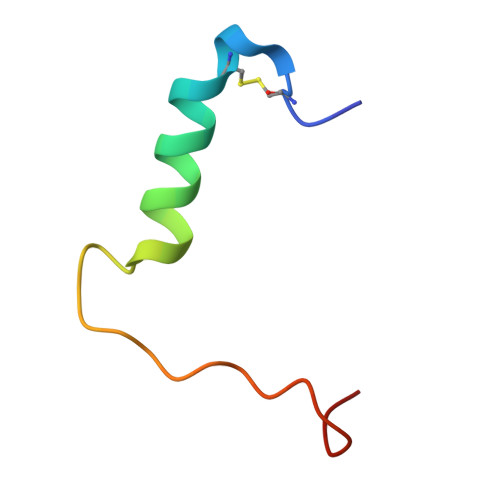
Ribbon representation of the experimentally modeled cagrilintide peptide chain, extracted by RCSB from its amylin-2 receptor complex.
Shown: Receptor-bound peptide model; a partial representation of the complete modified drug.
Cryo-EM, 2.80 Å. This ribbon shows the modeled peptide backbone and disulfide; it does not depict every atom or the full C20 lipid/linker. The receptor and G proteins are omitted. It represents one bound experimental conformation, not the sole shape in solution.
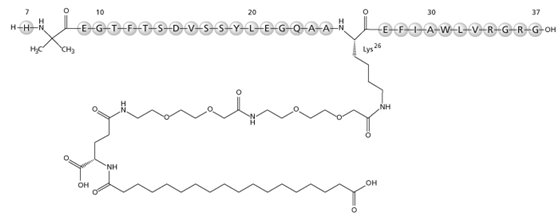
The active peptide and its covalent lipid/linker modifications, reproduced from the official product label.
Shown: Active peptide; formulation excipients excluded.
Official two-dimensional structural formula. The letters denote amino-acid residues; the lipid side chain and linkers are included. This is not an experimental three-dimensional conformation.
Novo Nordisk prescribing information via DailyMed/NLM
Novo Nordisk reported that CagriSema did not demonstrate noninferiority to tirzepatide in the open-label head-to-head trial. The company continued the program and anticipated an FDA decision later in 2026.
REIMAGINE 5 reported greater weight reduction and noninferior HbA1c reduction with CagriSema 1.0/1.0 mg versus tirzepatide 5 mg. Low-dose comparison, not versus tirzepatide 15 mg. No treatment-policy estimates, CIs or noninferiority margin recovered; no clinical-complication outcome. Do not supersede the different REDEFINE 4 comparison.
REDEFINE 9 reports weight loss with lower-dose CagriSema
The lower-dose regimen reported approximately 21% weight reduction over 68 weeks in adults without diabetes. Sponsor slides/topline only. Arm sizes, confidence intervals, treatment-policy estimates and ≥5% co-primary counts unavailable. Not evidence that lower doses are superior to higher doses across different trials.
CagriSema reports a Phase 2 painful-neuropathy signal
Novo reported improved pain ratings in type 2 diabetes with painful peripheral neuropathy, and plans Phase 3 neuropathy trials across its portfolio during 2027. Sponsor slide only, no CI or exact p-value; pain relief is not nerve regeneration or prevention of diabetic complications. Analysis and enrollment denominators differ.